Without Atlas
Because Ayn Rand Can STILL Go Fuck Herself

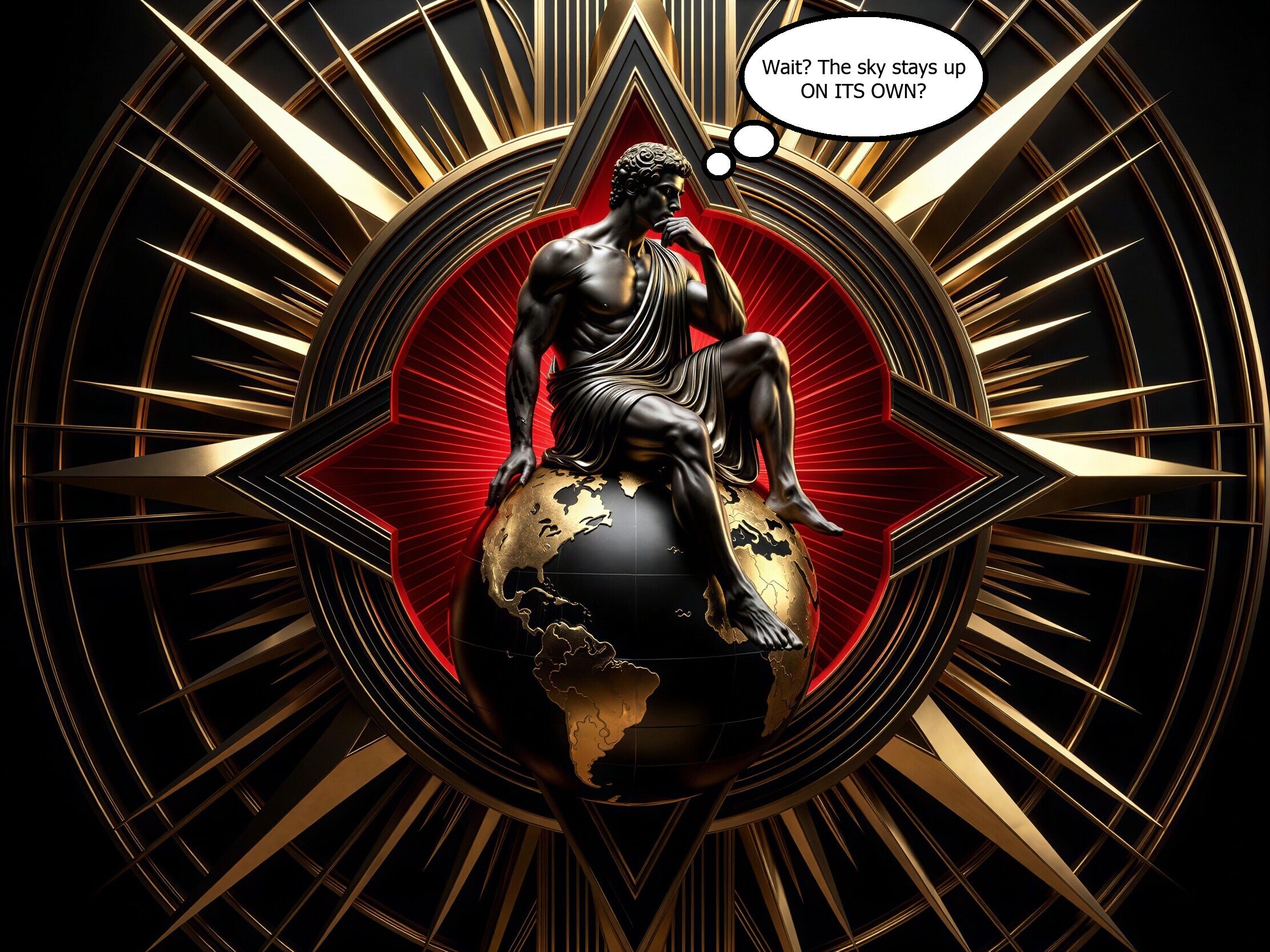
Story by Paul Victor Tims (Copyright), who asserts the moral and legal right to be identified as the author of this work. Written in response to probably the worst book ever conceived or penned. ‘Cover Art’ made using AI with the maximum possible level of laziness and contempt.
Daggenham Gilt had been a fine, chiselled fellow once upon a time: a captain of industry built like an Olympian and possessed of the kind of rigid rational mind to which merely human concerns like uncertainty and emotional malaise were totally alien. Staggering through the barren, rocky mountains that had sheltered him and his friends for nearly fifteen years, he was almost unrecognisable: haggard; scrawny of limb; flabby where his stomach muscles had dissolved under malnutrition and ill-maintenance; wild-eyed; gibbering quietly to himself.
His failure – and the failure of those like him – had been absolute. What a lark it had been, to begin with, to cock a snook at the society that tried to fetter and control his obviously superior ilk! The workers kept striking for better wages, whining that they didn’t have enough money to live on or to feed their children. The governments had tried to limit genius with trifling regulations over safety, until a man couldn’t even use high explosives to reshape the landscape to his business’s needs! The courts had demanded he – him! Daggenham Gilt! – and his associates be held responsible for the deaths their products occasionally caused, as though they’d never even heard the phrase ‘buyer beware’! So, one night, Daggenham had proposed a strike of his own.
It had come to him at Bohemian Grove, this idea, somewhere between doing blow off a dead hooker’s arse and setting fire to a giant wicker owl. Surrounded by the world’s most powerful and influential men – billionaires all – he’d found himself saying “What if we quit? The world would fall apart without us!”
The idea had caught fire. Without the producers, the moguls, the men of purpose, the moochers and nimbys wouldn’t last five minutes. They could go and build a society of their own and, when they returned, the world would be ready to abandon its petty regulations and welcome back its natural leaders with open arms.
Except, of course, things hadn’t quite worked out that way.
Gilt stopped, leaning on a jagged rock, and spat out a tooth that had been loose and aching for three weeks. The toothpaste manufacturer (an aptly named Mr. Grinn), had made a fortune from new and innovative formulae and, for this reason, had been included in the conspiracy despite being a mere multi-millionaire, not billionaire. As it had transpired, however, those formulae had been the products of his employees – the eggheads in his lab – and the Mogul’s Strike had run out of toothpaste in Year 4. It hadn’t even been the first sign of trouble.
In truth, Gilt’s only consolation was the knowledge of how desperately he must be missed by the little people; the dependants. He was returning to a society in desperate need of organisation and leadership; a world that would welcome him back with open arms, having fallen into decay without exceptionalism and genius to guide it.
It had never occurred to Gilt that making his first billion in the petroleum market and parlaying this into a series of high-profit corporate raids did not, in fact, put him in the same company as Einstein and Shakespeare.
For hours more, he pushed his way through the mountains, at last coming to a region of scrubland peppered with hardy, twisting trees and wending rivulets that did little to moisten the cracked summer-surface of the ground.
Images flashed through his mind at irregular intervals – reflecting, perhaps, the propensity of his battered neurons to misfire. Here was Jepstone, silicone valley’s greatest intellectual asset, smashing a long-term rival’s head in with a jagged rock and eating what came out. Here was Kennice Cathedy, entertainment executive at one of the major Streamers, screaming and running for her life, her hair on fire as her theatrical understudy chased her with a pair of gardening shears. Here was political lobbyist, Slithe Rusewater, eating his own fingers one at a time – just sitting amid the ruins of utopia and biting them off, calmly and methodically; chewing; swallowing. Why hadn’t they left sooner? Why hadn’t they run when it grew obvious the wheels had come off?
Gilt had never read High-Rise by J.G. Ballard, so the answers contained therein remained obscure to him. Actually, it had been nearly thirty years since he’d read anything widely regarded as possessing literary or philosophical merit. Who needed that pretentious, elitist gunk?
He pushed on, though he fell several times. Yes, the experiment had failed. Their society, organised not merely around liberty but it’s perfect expression, had run afoul of bad actors and unforeseeable circumstances, but if the best and brightest minds in the world had had a rough go of it… well! Just imagine what the rest of human civilisation must have come to in their absence! He was needed! The world he’d left behind would be crying out for strong leadership and it was this thought that kept him going.
If memory served, the city he’d once called home lay just beyond the next, low hill. He’d be able to stand at the crest and look down on it, like… he searched for a simile. He also hadn’t read Thus Spake Zarathustra.
He fell once more, coughing up bile. By the time utopia came to an end, the few medicines left had been impossibly, riotously expensive. Yes, they’d all been billionaires upon founding their private(ised) kingdom, but that was the problem with everyone being a billionaire. Even before scarcity kicked in, they’d been living in a hastily-concocted recipe for runaway inflation. Gilt understood this perfectly in retrospect, but if someone had told him before the whole thing fell apart, he’d have made snoring noises and said something along the lines “Number go up, nerd!”, calling it a day at that.
Of what, precisely, was he dying?
He had no idea, but his innards felt like soup.
No matter. Soon enough, he’d be healed. The moochers and loafers of the world weren’t good for much, but a lot of them – guided by some loathsome, impractical virtue like ‘compassion’ – did seem to go into healthcare.
Gilt struggled to his feet – a man of will! A man of iron! – and stumbled up the hill.
He came to the crest, panting and triumphant in the ragged remains of his suit. And there he stopped, his face contorting with some emotion he was not, truthfully, equipped to process.
The city he’d left behind lay spread out before him and it was… beautiful. The ruin of his imagination was swept away by the grandeur of reality. Gone were the featureless glass and steel skyscrapers competing for height, replaced with structures of elegant marble and brass harking back to humanity’s finest aesthetic eras: here, an art deco train station; there a library in full medieval gothic; here a local government office in swirling baroque; there an art gallery in the Beaux Arts fashion. It was Atlantis before the seas rose; Troy before Achilles; the Emerald City of Oz, sans wizard.
Rail-lines ran through the pulsing, glittering conurbation and every train had about it the perfection of the Orient Express. The roads looked broader, though this was only because there was so little traffic on them. The people went about on foot or public transport or, just as often, reclined outside cafes and by fountains, reading, laughing and going nowhere.
Daggenham Gilt would never know the vast ideological shift that had precipitated this transformation. He would never learn of the Year of Chaos that had followed the sudden departure of the world’s grandest pieces of living infrastructure. He would never hear the recording of a formerly minor politician, elevated by crisis, summing up the world’s new direction with two words: “never again”. He would never understand the effort it had taken the nations of Earth to divorce themselves from the whims of capital and imagine new economies, nor comprehend the wave of long-suppressed creativity this had unleashed. The way in which the world had survived – thrived, even – in the absence of its businessmen, bankers, money-men and corporate giants would remain forever opaque to him.
Gilt would never achieve understanding because he died on the hill. It was as though Atlas finally let go of the sky and, discovering that it stayed up well enough on its own, keeled over in sheer, indignant shock.
His corpse would be eaten by wildlife, unlooked for, before any mortician had the chance to diagnose total cardiovascular failure.
The last of the billionaires died on a hill overlooking his home town and the society he had divorced so contemptuously did not even blink.
FUN FACTS
Bohemian Grove is a real retreat where the world’s richest pricks meet up annually, free from the public eye or oversight by a regulatory body. Ostensibly, it’s just a holiday, but it represents such a concentration of money and power that its total independence and intense secrecy are, at best, concerning. It was fully exposed to the public in the Year 2000 thanks to the efforts of investigative journalist Jon Ronson, who ‘infiltrated’ the event by putting on nice clothes and walking in like he had every right to be there. That this worked is further evidence, if any were needed, that the rich are often amazingly stupid. The ‘dead hooker’ line is ghoulish exaggeration, borrowing more from Epstein’s crimes than the real-life Grove. The bit where they have a creepy ceremony and set fire to a wicker owl is, however, 100% real.
Ayn Rand’s novel, Atlas Shrugged is well-known for being about billionaire industrialists ‘going on strike’ and leaving the world to fall into ruin because, according to Rand’s insane Objectivist ethos, the world couldn’t possibly function without these allegedly high-achieving individuals. Rand never had a good answer for the inescapable fact that most captains of industry don’t actually do anything and just monetise other peoples’ inventions and hardwork, making Shrugged one of the most philosophically risible books of all times. What you may not realise, however, is that it’s over a thousand pages long and a substantial part of that is just Rand obsessing over trains like she’s in an episode of Love on Spectrum. It’s a lot, even for someone like me, who is also autistic. Obviously, the above story chooses to respond to the philosophical thrust of Shrugged, not its intensely weird fixation on railways.
An alternative title for the above short story was Atlas Shat, just to rub salt in the wound. In the end, however, as funny as it was, it didn’t make enough internal sense to actually use.
I stole the name Daggenham from a secondary character in The Stars my Destination, which is a vastly better book than Atlas Shrugged and written (as a cheeky bonus) by someone who wasn’t a train-obsessed, pauper-hating maniac.
Atlas Shrugged was published in 1957, which means it has been nearly 70 years… and Rand can still go fuck herself.
Really good, well done.
I just want to admit that I loved The Fountainhead when I was a 15-year-old teen (and had poop for a brain). But you grow out of stupidity, I only hope.
What an upliting vision- please, please let it come to pass. We need to send this to all those’indispensibles’ (hahahaha) who think like Gilt Daggenahm?